Saturday, February 27, 2016

Getting Out of the Fast Lane


For the first time since last Sunday we woke up as late as we wanted and we moved slowly.  Had breakfast at home, left the house at about 11.  Headed to Motril, about a half an hour to the east. Parked successfully (having a car can be a mixed blessing, for sure) in an underground garage and looked for the tourist information office.  It was not quite obvious enough for us so I went into a farmacia and used my pidgin Spanish and got directions.  Not much English spoken in this town, especially not by the people in the shops.

Views from our balcony, toward to sea ...
, \
... and toward the mountains
We headed for the only museum of this type in all of Europe -- a museum of pre-industrial sugar cane production.  Motril was the capital of sugar cane in the 15th and 16th centuries.  The Moors figured out about 500 years before that it would grow here, and somehow it arrived from New Guinea via India and Persia.  The warm weather and abundant water here is perfect for it.  Sugar cane pushed out all the other normal food crops and took over the economy of the area, but it was mostly exported or eaten by the very rich. It was a huge amount of work making sugar:  cutting it by hand with a machete, stripping the leaves, loading it onto donkeys, taking it to the mill, putting it through giant rollers powered by water, then resquishing all the smashed cane again by using a huge press (a lever with a fulcrum near one end; a man at the far end of a beam twisted a giant screw, lifting his end and exerting downward pressure at the other end about 40' away...the smashed cane was stacked just like the cider press at home, with layers sandwiched between, and they squished every last drop out), then boiling it over a hot fire, making a syrup, taking out the impurities, getting it hot enough to crystallize, then packing it into these ceramic jars to make a sugar loaf. Every single ceramic jar had to be broken to get the sugar loaf out, so someone had to make hundreds and hundreds of those cone shaped pots with a hole in the bottom (so the molasses could drip out). It was hard to understand the quantities, but they said this particular sugar mill made 822 tons of sugar (a year?).

There were many downsides to this enterprise, both ecological and societal.  It used up all the wood in the whole region eventually.  The sugar was taxed so heavily that the people who were making it really didn't benefit from the money that was flowing.  Eventually the New World became too competitive with its slave labor and vast capacity for production, plus someone else discovered sugar beets which was a whole lot easier than sugar cane.  The industry died out, was reinvigorated when steam power was invented, but ten years ago the very last sugar mill closed.

Motril is another port town, full of regular people doing regular shopping and work.  We did not find a quaint city center but there were certainly narrow streets lined with classic looking residential buildings, and fountains and squares, just nothing that looked ancient or precious. At about 2:00 the whole place closed.  We walked around trying to figure out how to find a wifi connection (the one at the library was too weak) and eventually found an open network when we were sitting in a plaza.  Jon discovered there had been no major crises at work. Then we had some lunch at an outdoor cafe even though it was getting cold and grey out.  I can order food as long as I don't have to construct a whole, coherent sentence.  

It turns out all those acres of plastic greenhouse structures are filled with a variety of vegetables and fruits.  Apparently about 20-some years ago this whole region started growing produce under cover during the winter months. It is too hot in the summer. The guidebook moans that this is unaesthetic and has lots of issues, but I would say that if they are producing most of the fresh fruits and vegetables in the winter for Northern Europe, more power to them.  They must have figured out that this works best, although it must create a different kind of problem-solving.  They work on some intensely steep slopes in this region.  I don't think there are many farms in the US that would attempt that.

Instead of going straight home we went up a long and winding mountain road to see the town of Competa, famous for its Muscatel wine and probably other things. By the time we got up there I didn't even want to get out of the car. It was getting dark and looked like rain and it was about 15 miles back down the same switchbacks all the way to the coast.  It was certainly picturesque, tucked up in the mountains -- the guidebook said that about half the residents are expats from Northern Europe.  

A "white" town: like little boxes rolled down the hillside until they stop, one on top of another.
Back at home, I finished reading Hotels of North America and Jon took a nap and read a Nero Wolfe book on his phone.  He says what we have been missing is all the Trump news.  Ah well.

Malaga


ANOTHER early morning, this time to get Benjamin to the airport in Malaga (there is an accent over the first "a" but I can't manage that on this keyboard).  Dropped him off at 8:00 and he headed off to Austria, via Rome.  We will miss him, and not only for his Spanish and his internet connection.  He is good company, and so patient with us (I still am always surprised).  He and Jon can talk for hours, and he is on my team when it comes to not worrying. He has a lot of confidence as a traveler, which makes everything seem easy.

So we were one our own, just like when Rebecca left us in Venice by ourselves after taking care of us through Greece and much of Italy.  We do need to take a trip with Alissa sometime so she can take care of us too!

We drove into Malaga, got our bearings by missing several key turns and driving all the way through the interesting part of town in both directions, eventually figuring out where to find a parking garage right in the old city.  Go us.  It was so early that the streets were still pretty empty of pedestrians and shops and restaurants were just barely getting open.  Malaga is a port city, first inhabited by the Phoenicians, then the Romans and so on.  We went into the big chunky cathedral (that is maligned in the guidebooks for its mix of architecture and dark interior) and heard mass being sung on the other side of a screen. As usual, the cathedral was built on the site of a mosque, about four or five centuries ago.

Wandered around in the pedestrian-friendly streets, stopped at a cafe to sit in the sun and drink cafe con leche and have churros with chocolate.  Went to the Picasso Museum and appreciated the beautiful building, the organization (thematic), the way they really want you to understand what Picasso was doing, and the small number of paintings (about 200 or so).

Went to the bustling market that was full of shoppers buying fish and olives and vegetables and fruits and meat.  We bought another round of beautiful vegetables, this time from an organic farmer, plus some delicious looking pastries and some olives and oranges.  Felt pretty pleased with ourselves.

The Costa del Sol.
My feet and legs were tired of all this walking on city streets, day after day, so we decided we had done enough in Malaga.  Cathedral, cafe, museum, market.  Good enough.  Drove to Nerja, our local beach town, and found a restaurant for lunch. Jon got tapas and I got fish. Food is fresh and wholesome, and pretty unadorned. Nothing to complain about except the lack of garlic, really. By now it was 3:00 and time for a nap. We drove down to the beach and parked in the sun and took naps.  After driving around trying to figure out where there might be wifi, with no success, we headed back up toward our house, taking a detour into the older and more scenic part of Frigiliana.  So many gleaming white buildings stacked up on that steep hillside, looking down over a long green valley, all the way down to the sea.  It could not be more picturesque-ly Spanish.

Between all those houses on the hill-side are groves of olives, or
vegetables or citrus or avocados.
Like yesterday, once we got home, we didn't want to go back out again even though there were still two more hours of daylight. With no internet, we had to read books.  And take some more naps.  And then cook a yummy dinner using yesterday's pasta as a start for another round of vegetables and olive oil.  This is so deluxe, having a house with a stocked kitchen, fully furnished with everything we could ever want.  It is a dream destination.  Except for the lack of a wifi connection - which we could purchase but it seems too extravagant to Jon so instead we will hold onto our money and wait for another solution.

Frigiliana, another "white" town.

Alhambra


Since there are no furnishings ...
... in the Alhambra, all the ...
Another early morning -- at 6 AM it is still dark as night out and there are almost no vehicles on the roads. We were in a hurry to get to Granada to pick up our tickets for an 8:30 entrance into the Alhambra.  Until a few days ago, I had never heard of this place.  Lonely Planet in 2011 said it is the top spot to visit. So Jon ordered tickets online and we headed back north.  It was frosty and clear and Benjamin with his thin Israeli blood was freezing while we stood in line waiting to be among the first.


... views are up  ...
... until you get outside.
The Alhambra is a fortress, a royal palace, part of a complex with a long history. Last year we went to the Topkapi Palace in Istanbul, it also had housing for the harem and a throne room, etc. This building is different because it has been painstakingly renovated with room after room of intricate decorative plaster, inlaid wood ceilings, tile floors and walls.  The trouble is, there were almost no signs telling us what we were seeing -- except for the explanations about the renovation process.  Obviously the people who have spent so much time recreating this Moorish/Christian building are very interested in that aspect, but we would have liked to have some context.  Again, I really missed having a movie to explain everything.  That is so normal in the US, the movie, a good narrative makes all the difference.  There were grand hallways and fountains and sculptures. I like to be able to imagine the people who lived here.  The Topkapi Palace did a much better job.  There were other grand buildings in the complex -- Charles V, who had royal palaces all over Europe (Holy Roman Emperor) wanted a more comfortable and modern place to live here so they started building a big round Renaissance structure with a big open courtyard in the middle, Greco-Roman columns all around the perimeter.  It took them over 400 years to finish it.  We wonder why they thought it was important to finish it, since those royal families were long gone.  There were some great views of Granada and the Sierra Nevada mountains from on top of the towers of the military fort.

From a parapet, looking back at the palace.
Looking up into the Sierra Nevadas.
Looking out over Granada.

Running water where handrails
would be.
View of palace complex from
some of the newer gardens.


Hana, trying to join a work crew, but she forgot her green and blue jacket.
We went into the center of the city, braving the traffic, driving on forbidden roads by mistake but leaving quickly enough, eventually found a parking garage and set off on foot to find lunch and sightseeing.  Another sunny, warm day by then so we sat outside in a touristy block of restaurants, watching the crowds of school children go by.  Lunch, then wandering, then some gelato, then back to the car. Benjamin said that Granada felt mostly like a European city but he couldn't get a feeling for its unique character. We probably didn't try hard enough.

The view of the mountains and valleys was much clearer this time -- snow on the peaks and rugged, craggy, shadowy ridges. 

We stopped at a big supermarket in Nerja where many of the signs were in English as well as Spanish because this is a big destination for British tourists.  They were in evidence.  Apparently many have timeshares here and spend the winter months in the sunny south.   We bought nice vegetables and other supplies and headed back up the valley to our whitewashed village in the hills.  

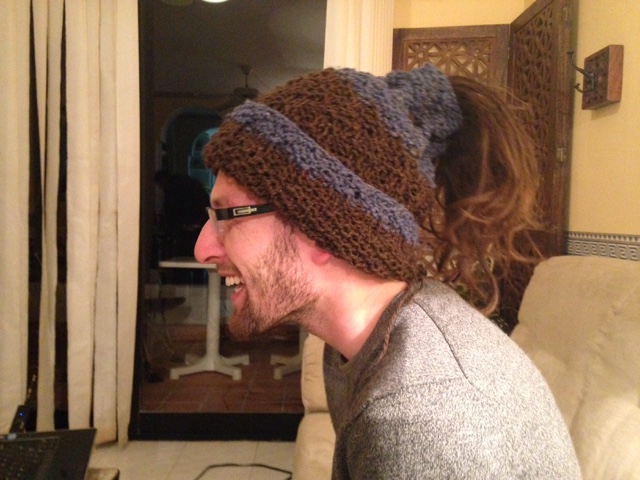
Benjamin got two new hats on this trip, a total success.
Naps, knitting, eventually we decided we didn't want to go out for dinner so Jon cut up some vegetables and made pasta and used lots of olive oil and salt (we finally noticed they don't really eat garlic here).  I finished making Benjamin's hat and he put it right on and said it was great.  Whew -- the last thing I made him was not a success, with its too long sleeves and its stretched out body.  This hat uses the same pattern that Nell used for Becca: it has a hole at the top for a ponytail to stick out.  Nell sent me the pattern less than an hour before we left on this trip, and I grabbed some yarn from my stash and started knitting at the airport.   While Jon and Benjamin reviewed the rules and strategy of backgammon (using a board that B. drew on some paper and all the coins they could scrounge to use as checkers), I made some fingerless gloves, to Benjamin's specifications: narrow wrist, wider at the palms, narrow again at the top.  The second one was better than the first.  So now he has a wool hat and gloves to wear in Austria this weekend.  They played backgammon and talked about mathematical probabilities before each move.  

Jon gave Benjamin his leather hat, saying that now that he has found one he likes he will be able to find another.  

We have not been able to post any pictures because we have been using Benjamin's phone as a hot spot (leaving us tomorrow) and it just isn't quite strong enough to do that task.

Friday, February 26, 2016

Off Line

Ever since Benjamin left us yesterday, we have been without the Internet. But I am dutifully writing posts to be shared when we get back on line. At the moment we are sitting in a quiet square in Motril using someone's open wifi after unsuccessful attempts at a public library.  On our tenth day of beautiful weather. Like Hawaii but a little cooler.

Woman at market selling one bunch of leeks, one endive, two cabbages and one bunch of chard.

Tuesday, February 23, 2016

La Costa del Sol and the Rock

The Army Corps of Engineers
(or the equivalent)
commissioned their own
statue, as would we all,
given the chance.
We didn't realize that we were coming to such a tourist-centered area, but since we are traveling during the off season it is hard for us to tell what usually happens around here.  The whole coast is a long stretch of hotels and resorts and golf courses and fancy houses.  Our apartment is uphill from all of that, but apparently in the summer this little town is also inundated with tourists.

After reading through the Lonely Planet guidebook that Laura passed on to us, Benjamin decided that today we should go to Gibraltar.  I have to say I didn't even know such a place existed, except sort of mythically.  It took two hours to get there (the roads are very good, if expensive) and then we showed our passports to the guard and were driving into a British territory, or something along those lines.  Britain controls this four mile peninsula, a giant rock with a small town at the base and a very long history. We parked and went to study a map on the main pedestrian street.  Immediately a gentleman with a comically perfect British accent offered to help us, and showed us how to find the Gibraltar Museum.  The street was filled with shoppers speaking mostly Spanish and English, and there were tea shops and pubs and red telephone boxes and post boxes.  It was hard to take it seriously, but we did have to change some money to spend pounds instead of euros.


Two big macaques, one very small.
The museum was sort of musty -- a series of signs and paintings and photos and documents telling the story of this piece of ground, and its natural history too. The building housed some medieval baths which have been excavated. There was an Egyptian mummy in pretty good condition that had fallen off a shipwrecked boat traveling from Egypt to Britain, scooped out of the ocean by a Spanish fisherman. We were sorry the room with the movie was being renovated because it would have helped to tie all these disparate elements together.   Gibraltar has been strategically important over the years, it withstood a four year seige in the late 1700s (the French and Spanish were trying to get the British out), and it is also a unique environment because of its climate and separation. Neanderthals lived here the longest, as well as many species of birds and mammals. There are still macaques roaming around.

Lunch was at a pub. We sat outdoors in the glorious sunshine (about 68 degrees, clear blue skies) and ordered fish and chips and bangers and mash from the waitress who spoke everything. As the guidebook had said, the food tasted like England in the 1970s.  That's when I lived there, and I can vouch for it. Filling but not excellent. Benjamin got a good vegetable soup, at least.

Jon has been thinking about a certain hat for years, and even tried to buy one from Amazon before we left.  But Amazon made about three different mistakes (uncharacteristically) and sent the wrong size hat to the wrong post office, not giving him correct information on the location of the package.  Anyway, I said that maybe he could buy a hat in Spain.  Turns out no one wears hats in Spain.  But they do in England. So Benjamin and Jon actually bought a hat, for a price that Jon could live with, and Benjamin put it on and wore it for the rest of the day. He looks like a guy in a Western, except for the dreadlocks.

Looking back toward Spain.

Benjamin, with new hat and new friend on rental car.
Then we got the car out of the car park and headed up the big hill for our driving tour of the rock. Many people were walking up the steep road and Benjamin felt that we were doing it all wrong but I was just as glad not to be walking up and down all those intense slopes.There wasn't all that much to see but the views were awesome. And we did visit with some monkeys who barely paid us any attention. When we got back to our parked car, there was a macaque sitting right on top of it, warm in the sun.  At the end of our tour there was tunnel in the middle of the rock to walk through but it was extremely civilized, with lighting and a paved walkway and signage and even military music (completely different from the tunnel in Jerusalem, in every possible way). We learned about the siege, how they invented more sophisticated ways to aim cannons and to get the cannonballs to explode in the air instead of just landing in the sand with a thud.  War does bring out the best in humans, yes it does.

Like the "Guns Of Navarone" (WWII novel reference).
We wrote a few postcards so we could send them with British stamps and then we bought some McVities so we could spend some more pounds and then we headed home on the coast road.

We had dinner in Frigiliana at one of the few establishments that was open. It ended up being perfect.  Nothing written in English, only Spanish spoken, but we each got a nice meal that wasn't exactly what we expected but was perfectly fine. Mine was the best because I got a mix of seasonal vegetables cooked perfectly, seasoned only with salt, in addition to a skewer of some meat that might have been pork tenderloin. They are not into seasoning beyond olive oil and salt here.  And we sat out on the veranda, away from the smoke and the noise of the game on the TV.  There was a full moon and stars and it was warm enough to be without a jacket, although it might have been a little better with one more layer.

Monday, February 22, 2016

Road Trip from Pamplona to Frigiliana


We were on the road by 8:00, heading south.  In Spain they do not put any hints about east/west/north/south on their signs.  They just put the name of a town that is ahead, usually a major one.  We americanos miss the sense of direction greatly, especially as we occasionally head off in the wrong direction, not really knowing which towns are relevant all the time as we are relying on erratic GPS information through the phones.  Not my problem, I just go where they tell me when it is my turn to drive and if we get off course they eventually find us and get us back on track.

We drove through big agricultural spaces all day long. In the morning it was mostly vineyards, patchworked up the hills on both sides of the roads, in addition to olives and green cover crop.  Both today and on the trip from Barcelona there were big wind turbines on the ridges and acres of solar panels sprinkled around. For the first half of the day it didn't seem like there were any houses or tractors or farm equipment associated with the fields (where do the people live who do all this work?) and then when we got closer to Madrid there were small farms with houses and trees around them.  And the olive trees kept on coming.  

De rigeur picture of picnic table.
We stopped at a supermarket on Ocano and bought lunch and then we stopped at a rest area and had a picnic, always my favorite.  Bread and cheese, hummus, lettuce, yogurt, orange, a sweet coffee and milk drink -- all for about 12 euros total.  

While the boys napped and I drove I began to notice that the olive trees were endless.  For over an hour, at 120 km/hour, there were olives growing all the way to the horizon, up the hills and over the plains. When Benjamin and Jon woke up, we talked about the incredible number of olives and of course Benj did some research since we couldn't even begin to describe the quantity. He read that there are 300 million olive trees on 5 million acres in Spain and most of them are right in the region we were crossing through.  In 2012, an especially good year, Spain produced almost half of the world's entire olive oil crop.  Italy came in second with 25%, Greece was third with 20%.    In recent years there has been a bad pest that has damaged the crops in Europe and Tunisia has stepped up production.  But still Spain ends up pressing most of the olive oil, and Italy ends up blending and packaging the most.  Or so says the google.

Very hard to relay how the olive trees go on as far as the eye can see.
Meanwhile, we were hurtling down toward the coast, traveling about the same distance as between DC and Boston -- but so much easier driving and so much more beautiful.  It was hazy, which was too bad, because we couldn't see the Sierra Nevada mountains clearly.

Finally we got to the east-west road that would take us to our destination, Frigiliana, about 6 km inland from the coast.  We went east instead of west for a while, which made Jon fret, but we saw acres and acres of some mysterious crop that was shrouded in a tight cover.  We have to find out what is inside those plastic structures   wrapped up so snugly. It can't be olives, unless the fly is particularly terrible near the coast.  

We arrived at our lovely apartment which we have rented for a whole week -- a friend of our neighbors owns this place.  The back balcony overlooks a deep chasm in the mountains, and way down the hill we can see the Mediterranean.  The town is perched on a steep hillside, rows of white houses along curvy narrow roads, all very tippy.  After we got ourselves settled in, had some tea, read the guide book about local points of interest, we decided it was time to go out in search of dinner.  We have been trained to think that dinner is not until 9:00 at the earliest but when we walked around, almost everything was dark and closed.  After about two blocks we decided we were not that hungry anyway and we would go home and make dinner from the leftover groceries plus things that were nicely left in the pantry.  It was still a mulit-course dinner with salad, soup, bread and cheese, a fried egg, an after dinner hot drink and chocolate.  We know how to camp.

Jon found a lizard from Muskitz hiding in our dirty clothes and Benjamin caught it for us, then tortured me with it before letting it go outside.  Poor lizard has been moved to an entirely alien climate. 

Benjamin is with us for two more days so he gets to choose what we do until he leaves.  We can be lazy after he goes.  

Sunday, February 21, 2016

Muskitz, Day Two


We all slept as long as we wanted this morning, wandering into the kitchen whenever we got up.  Found nice rolls baked by Uxua (sister of Ramon, not niece), tea, fruit.  By about noon we were all ready for some low level activity -- although it must be said that Ramon's brother Mickey was cooking up a storm in the kitchen. He had pots bubbling on many burners, preparing the vegetables for a huge dish for dinner.

Ramon's siblings and in-laws arrived through the day, and by lunchtime they were all here:  Mickey and Teresa, Koldo and Sylvia and daughter Uxua, Maria, Uxua, Javier, Inaki, Ramon and Laura, Marta and 3 year old Otto. Their oldest brother Juan died about ten years ago.

Un-renovated house to the left.
In the meantime, Laura and Peio took us on a full tour of Muskitz. First we went through the whole house from top to bottom. Then we went next door and explored the uninhabited house that the family owns but cannot possibly afford to renovate right now. They put a new roof on a few years ago, to keep it from falling down.  In the lowest level it is very spooky, with cobwebs dripping from the large oak beams, and chickens and rabbits living in cages.  Someone takes care of them.  The middle level has a vast hallway down the middle with five doors on each side.  Bedrooms, kitchen, dining room.  The kitchen has a huge chimney over the center, a cone that carries the smoke from the fire, up and out.  The top level is one huge space -- the whole building, which must be 80'x100' (wild guess).

Pretty loud when so close.
A reasonable distance when the
bells ring.
We went to see the recently renovated village church, even climbing up into the bell tower (which surprised us by ringing at 1:00 and then again at about 1:01 and then about 20 times...we couldn't figure it out).  Saw the new space for a new gastronomic society that Peio and Antxon now belong to (so much like the common house, but with a beautiful bar) and three apartments above that are soon to be rented.  They got funding from the valley (all the villages in this valley, together) to renovate the building, and the valley will get the rents from the building for the first 30 years.  Very cool.

I can absolutely imagine Peio being the mayor of this village at some time. He is exactly the same here as he was in Virginia. He stops and talks to everyone, everyone is a friend, he is interested in every possible conversation. 
From Benjamin's seat at the table.

At left, tuna, canned by Mickey; in center, big pan of
vegetables with white asparagus spokes and
fried cauliflower; and at the right, a salad of
pickled onions and olives.
Dinner was at about 2:30.  All the family around the table, with the English speakers clustered at one end.  First course was pickled onions and olives, second course was a giant pot of vegetables and ham and eggs (artichokes, cardoons, cauliflower, asparagus) called Menestra (mixture) that was a masterpiece, third course was sausage from their own pig, and for dessert cheese and nougat candy.  Then coffee and conversation.  Various people drifted off to the couches or chairs for a nap.  The family sat in small groups, big groups, hanging out for hours.  I typed and typed, trying to catch up with the last few days.  Benjamin and Peio and Jon went out for an early evening walk in the hills.

Javier (not sure of relation), Inaki, Mickey, Koldo, Uxua (the younger), Antxon (standing) and Sylvia
during the cheese course.

10:30 PM update -- 
We are now back at the apartment in Pamplona, have said goodbye to Peio who went back to school about 100 km away (a school for Basque people only, training them in maintaining and fabricating industrial machinery), and have had yet another delicious meal.  Chicory raw and cooked, both delicious. Not bitter at all, just like lettuce in salad or like spinach or chard when cooked.  Eggs, then cheese and apple jelly for dessert.  More lively conversation about the chicken/egg question, snapping turtles, and Laura's grandfather and father's life work spreading adult literacy throughout the world.  Tomorrow we leave the cozy care of the Ayestaran family and head south.